
Corpus Christi is a celebration of profound faith, devotion, and tradition, where the streets of Cusco transform into a stage filled with color and fervor during the procession of saints and virgins from various parishes.
In the city of Cusco, a celebration takes place that fascinates both locals and visitors alike: Corpus Christi. This year, on June 19th—a Thursday steeped in tradition and devotion—the streets will come alive with the procession of sacred images from different parishes. As a fundamental part of this festival, people enjoy the iconic Cusco dish, Chiriuchu, which adds a special flavor to this cultural experience.
Corpus Christi is a Catholic religious celebration in honor of the Blessed Sacrament, recognizing the real presence of Christ in the Eucharist. The name comes from Latin and means "Body of Christ." The festival takes place on the Thursday following Trinity Sunday (which occurs the Sunday after Pentecost), falling between late May and mid-June.
Before the arrival of the Spaniards, the Incas held festivities of great spiritual significance, such as the veneration of Inti, the Sun God. These ceremonies also included processions carrying the mummies of past rulers—a ritual to honor ancestors and nature.
With the arrival of Christianity, these practices were transformed through a process of religious syncretism. In 1572, the procession of mummies was replaced by one featuring saints and virgins, giving rise to what we know today as the Corpus Christi Cusqueño.
The festival begins a day before the main event with the entry of the saints. On the preceding Wednesday, the images from different parishes head first to the Temple of Santa Clara, near the San Pedro Market, before advancing toward the Plaza de Armas and the Cathedral.
This parade gathers 15 saints, each accompanied by comparsas (dance troupes), music, and traditional dances that reflect the community's devotion. Among the most anticipated are Saint Jerome (San Jerónimo) and Saint Sebastian (San Sebastián), who participate in a symbolic race down La Cultural Avenue toward Santa Clara. Saint Barbara (Santa Bárbara) also stands out, arriving from the province of Poroy to join this celebration filled with fervor, color, and music, anticipating the majesty of the central day of Corpus Christi in Cusco.
The central day of Corpus Christi begins early in the morning as crowds gather on the steps of the Cusco Cathedral and around the Plaza de Armas to secure a good spot and participate in the festivities. The images of the saints and virgins are placed in front of the Cathedral, where they await the start of the Mass and the beginning of the procession.
The main event begins with a Pontifical Mass presided over by the Archbishop of Cusco, with the participation of civil, military, judicial, and religious authorities, as well as brotherhoods, students, and the faithful. This ceremony usually takes place between 9:30 AM and 10:30 AM. During the Mass, the Gospel is proclaimed, and reflections are shared regarding the meaning of Corpus Christi.
At the end of the Mass, the procession of the sacred images begins. The route opens with the presence of the Blessed Sacrament and concludes with the revered image of the Virgin of the Immaculate Conception.
Following the Mass, the solemn procession of the Blessed Sacrament begins. It is represented through the consecrated host, which symbolizes the body of Christ. In this march, priests and pastors organize themselves into two lines on either side of the Sacrament, while the Archbishop leads the procession. This sacred event loops around the entire Plaza de Armas and kicks off the impressive parade that brings together all the images of saints and virgins, enveloping the city of Cusco in an atmosphere of deep faith and cultural tradition.
Saint Anthony is the first saint to begin the Corpus Christi procession in Cusco. Born in Egypt, he distributed his inheritance among the poor at age 18 to live in the desert, dedicating his life to prayer. He died at the age of 105 on January 17, 356.
As the patron saint of swineherds, his image is dressed in a cool-toned suit that changes every year. He carries a silver staff, a book, and a pig as his symbol. Pig merchants decorate his litter (andas) and accompany him with the music of pututus (conch horns) and a band. Ahead of him, the carguyoq (festival sponsors) carry the processional banner, followed by women with lit candles and young men carrying a bench to rest the heavy image, alongside numerous parishioners from the San Cristóbal parish.
Saint Jerome is the second saint in the procession across the Plaza de Armas. Born in Dalmatia to Christian parents, he was baptized in Roma. Educated in France and Greece, he led a solitary life in Syria, where he defended the faith. He was ordained as a priest by Saint Paulinus, Bishop of Antioch, and was later called to Rome by Pope Damasus to write epistles. He retired to Palestine, where he founded the Monastery of Saint Paula in Bethlehem and translated the Bible into Latin. He died on September 30, 420.
During the procession, Saint Jerome follows Saint Anthony the Abbot. His image, from the San Jerónimo parish, is imposing, wearing a red hat and a scarlet robe. Recognized as the patron saint of theologians and the "Great Doctor of the Church," he holds a golden quill and a church over a book. Sculpted by Luis Ramírez, the image is carried by nearly sixty men. Accompanied by two marching bands, Saint Jerome processes followed by devotees and local authorities, all holding lit candles.
Saint Christopher is the third saint to participate in the Corpus Christi procession in Cusco. Of Canaanite origin, he was a Christian martyr who fought against the Persians and later preached in Lycia, performing miracles that led many to the faith. Captured and tortured under Emperor Decius, he was beheaded in the year 254, and his feast day is celebrated on July 25. The statue of Saint Christopher, patron of the neighborhood that bears his name, is imposing and muscular. Originally so large that it had to be trimmed down to fit through church doors, it depicts the saint crossing a river with the Christ Child on his left shoulder, leaning on a tree trunk.
During the Corpus Christi procession, Saint Christopher is carried by his devotees and neighborhood authorities. Accompanied by traditional music, he advances among numerous parishioners from the San Cristóbal neighborhood in Cusco. His image, one of the heaviest, requires a massive effort from the carriers, highlighting the devotion and commitment of the community that accompanies him every year.
Saint Sebastian is the fourth saint in the procession. He was a noble soldier highly esteemed by Emperor Diocletian. Despite being a Christian, he used his position to help other imprisoned Christians. Discovered by the emperor, he was tied to a tree and shot with arrows. Thinking he was dead, they left him, but a pious woman named Irene found him alive and nursed him back to health. Ultimately, the emperor ordered him to be beaten to death on January 20, 288. The image of Saint Sebastian, created by Melchor Huamán in the 17th century, portrays him tied to a tree with four arrows adorned with precious stones.
During the Corpus Christi procession, his image, dressed in a finely embroidered robe, is carried by several lifters all the way from his parish, located five kilometers outside the city. The procession is preceded by a priest, local authorities, and religious brotherhoods, and is accompanied by countless parishioners. A band of musicians follows the route, playing drums, bass drums, and cornets.
Saint Barbara is the fifth in the procession. Born in Nicomedia, she was a virgin and martyr, daughter of Dioscorus, an idolatrous nobleman. She converted to Christianity, and upon learning of her faith, her father locked her in a tower. Her devotion was so strong that she built three windows in the tower to honor the Holy Trinity. When her father discovered this, he tortured her to make her renounce her faith, but she stood firm. Finally, he beheaded her on December 4, 238, and as punishment, he was struck down by lightning from heaven.
During Corpus Christi, Saint Barbara arrives from the town of Poroy, carried by her devotees. Her image depicts a pale, melancholic woman holding a silver chapel in one hand and a branch in the other. Although she is no longer on the official Catholic calendar of saints, she continues to be venerated with great devotion. Her litter, decorated with silks and artificial flowers, is accompanied by marching bands, the priest, sacristans carrying the High Cross, local authorities, and numerous parishioners. Devotos dressed in traditional ponchos and chullos (Andean earflap hats), as well as formal suits, walk all the way from Poroy to accompany her image.
Saint Anne, mother of the Virgin Mary and wife of Saint Joachim, is the sixth in the Corpus Christi procession. Native to Bethlehem and from the lineage of David, she dedicated her life to prayer and charity. After 20 years without children, an angel announced to Saint Joachim that they would have a daughter, Mary, whom they raised with love and offered to the temple at age three. Saint Joachim died shortly after, and Saint Anne spent her final days in prayer.
In the procession, Saint Anne arrives from her parish located in the high hills of Cusco, holding the child Virgin Mary in her hands. Although her expression is stern, it reflects a sweet demeanor. The image wears bright, vibrant garments and is accompanied by many parishioners, especially women and children. A marching band follows behind her, completing her section of the procession.
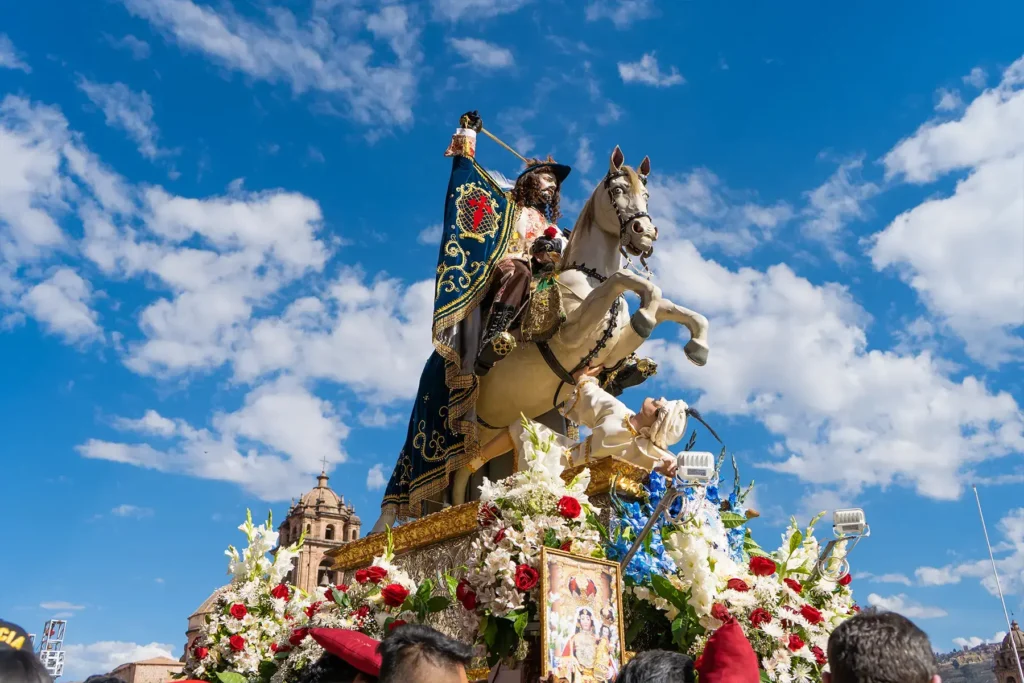
Saint James the Apostle, known as James the Greater, is the seventh in the procession. Son of Zebedee and Mary Salome, he answered Jesus' call without hesitation while fishing in the Sea of Galilee. He preached in Jerusalem, Samaria, and Spain, where the Virgin Mary appeared to him in Zaragoza. After returning to Jerusalem, he was martirized by Herod, and his body was later transferred to Galicia. He is venerated as the patron saint of Spain and has been a historic symbol in their wars.
In the procession, the image of Saint James stands out due to his defiant posture, mounted on a white horse and wielding a silver sword. He wears a feathered hat, black boots, and a suit that changes colors every year. By his side, a Moor appears in a pleading posture, holding the horse. Saint James is especially admired by children and advances accompanied by the parish priest, district authorities, and a massive crowd of devotees.
Saint Blaise, the eighth in the procession, was a bishop and martyr from Armenia known for his devotion and virtues. Named Bishop of Sebaste, he lived as a hermit on Mount Ageo, where he healed both sick people and animals. When he was discovered by the prefect Agricola, he refused to worship pagan gods, leading to his imprisonment, torture, and eventual decapitation on February 3, 289.
The image of Saint Blaise in the procession portrays him with his right hand raised in a gesture of blessing. He wears a bishop’s mitre (bonete), carries a golden staff, and is dressed in a scarlet robe with a dark beard that accentuates his solemn figure. Devotees carry him with enthusiasm after enjoying local snacks and chicha de jora (fermented corn beer). They are accompanied by acolytes and altar boys in colorful clothing, as well as the priest, sacristans, local authorities, and parishioners dressed in ponchos and chullos. The image of Saint Blaise is carried on a litter carved from fine wood in the classic Cusco style.
Saint Peter, the ninth in the procession, was the Prince of the Apostles. Born in Bethsaida and brother to Saint Andrew, he worked as a fisherman until Jesus called him to be a "fisher of men." Although he denied Christ three times, he repented and became the leader of the Church. After receiving the Holy Spirit, he preached across Asia and finally in Rome, where he was crucified upside down by order of Nero in the year 68.
In the procession, the image of Saint Peter shows him as an elderly man with a stern face, holding a bunch of silver keys and a tinsel papal tiara. Although he has fewer followers than other saints, his devotees stand out for their intense fervor. He is accompanied by the parish priest, sacristans, a marching band, and children who carry the bench used to rest the image. The litter, made of finely carved wood, is kept in excellent condition, showing the community's deep respect for the saint.
Saint Joseph, the tenth in the celebration, is known as the husband of the Virgin Mary and the foster father of Jesus. Coming from the lineage of King David, he was born in Bethlehem and was characterized by his justice and virtues. God chose him to be the guardian of Jesus and Mary. He passed away at the age of 69, and according to tradition, Jesus healed him before angels carried his soul to the Bosom of Abraham. On December 8, 1870, Pope Pius IX designated him as the Patron of the Universal Church.
During the procession, Saint Joseph is depicted holding the Infant Jesus in one hand and a staff in the other. His garments are typically dark or cool colors, and he wears a silver crown. The image is accompanied by women, men, and children, alongside nurses walking by his side, while marching bands liven up the route shared with the Virgin of Bethlehem, as both images originate from the Bethlehem parish. The litter on which he is transported consists of two sections: a silver-plated upper section and a wooden lower section.
The Virgin of the Nativity, eleventh in the procession, celebrates the birth of the Virgin Mary, daughter of Saint Joachim and Saint Anne after 20 years of childlessness. The image, sculpted in the 17th century by Juan Tomás, stands out for its delicacy and was commissioned by Bishop Mollinedo. Carved from a single piece of wood, it shows the Virgin holding the Infant Jesus in her arms, with an angel behind her holding a parasol.
During the procession, the priest and sacristans carrying the High Cross open the path, followed by the mayordomía (festival committee) and women dressed in typical Cusco attire carrying candles and flowers. Additionally, a group of women in traditional indigenous clothing carries banners honoring the Virgin. The carriers, along with numerous parishioners from the Almudena neighborhood, accompany the image with devotion to the rhythm of a marching band, reflecting the faith and tradition of the community.
The Virgin of the Remedies, twelfth in the procession, is a figure deeply venerated by the people of Cusco. Since 1980, she has participated in the festival on a litter of repoussé silver, thanks to the support of the then-Archbishop of Cusco, Monsignor Luis Vallejos Santoni, and the prioress of the Santa Catalina Convent. The image stands out for its splendor, adorned with gold and silver crowns, jewelry such as rings and earrings, and a pectoral set with precious stones. She is accompanied by an angel carrying a parasol, sporting silver boots and wings.
According to the writings of Parish Priest Contreras y Valverde regarding Cusco between 1649 and 1650, the Virgin's chapel used to be packed with faithful followers bringing candles, flowers, and offerings, especially during festive days. The Virgin of the Remedies reflects the deep devotion and tradition of the community, adding solemnity and beauty to the procession.
The Purified Virgin, thirteenth in the procession, represents the purification of the Virgin Mary and the presentation of the Child Jesus at the temple. During this event, the elderly Simeon prophesied the Savior's destiny, and Anna recognized him as the Messiah. The Catholic Church commemorates this act between January 24 and February 10, inviting the faithful to bring candles as a symbol of Christ's light.
This image comes from the Temple of San Pedro and stands out for its elegance, featuring a gold crown and a scepter. Since colonial times, she has been especially beloved by parishioners. During the procession, the parish priest and sacristans lead the way, followed by female devotees carrying candles, wax offerings, and banners, demonstrating their faith and devotion to this sacred figure.
The Virgin of the Bethlehem, fourteenth in the procession, comes from the Church of Bethlehem and marches accompanied by the image of Saint Joseph. She is one of the most highly venerated due to her reputation for performing miracles, which has earned her valuable gifts from her devotees, accumulating jewels, crowns, cloaks, and robes. Her silver litter is the heaviest and most expensive, making its transport an impressive spectacle due to the sheer strength required.
Affectionately known as "Mamacha Belén," tradition states that this image was a gift from Emperor Charles V of Spain. A popular legend recounts that a character known as "El Selenque" helped stabilize the litter when it was on the verge of tipping over on the Bethlehem bridge. Believers consider that had the image fallen, the city of Cusco would have suffered a immense tragedy, reflecting the profound devotion and sense of protection that Cusco locals feel toward this sacred figure.
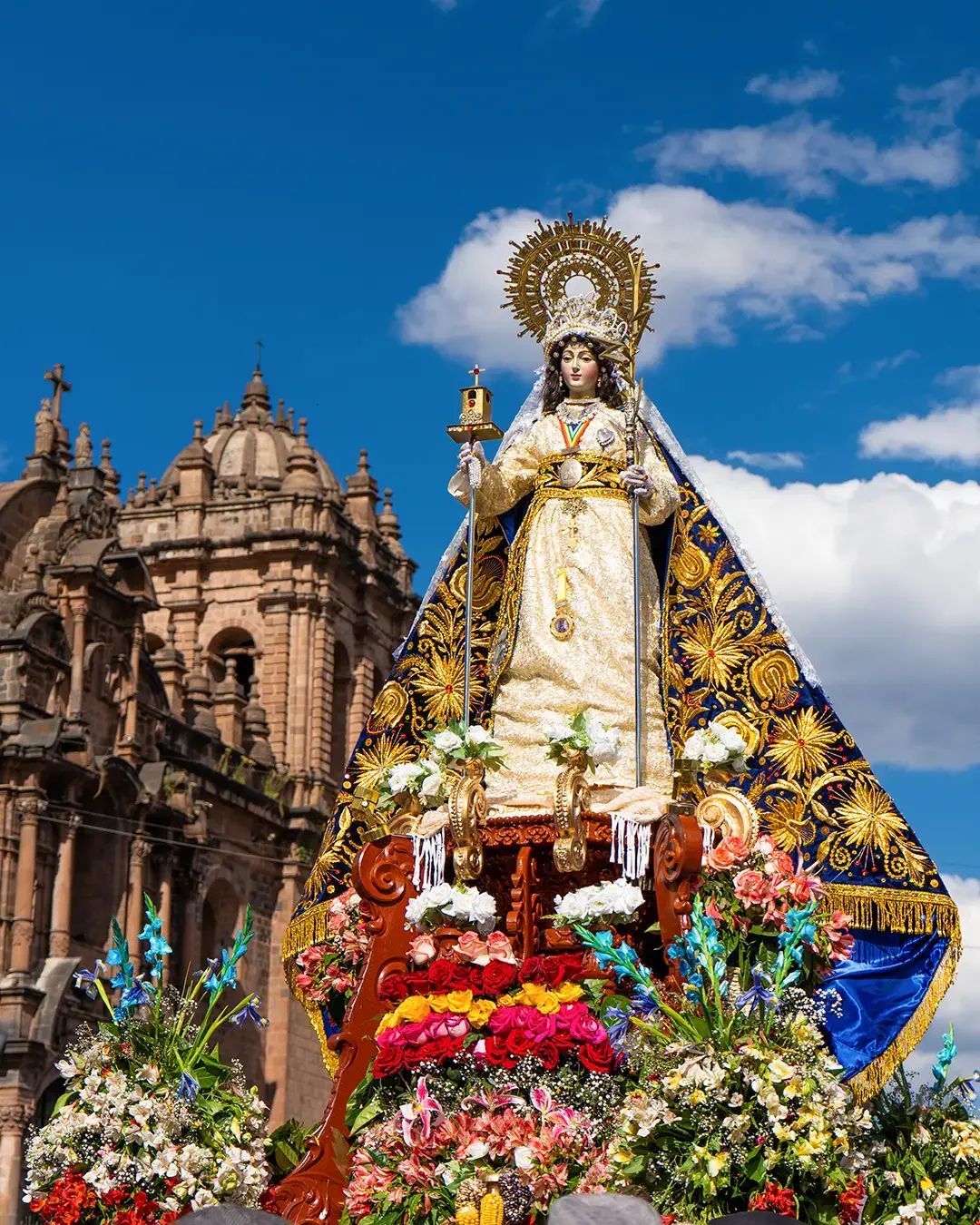
The Virgin of the Immaculate Conception, known as "La Linda de la Catedral" (The Beautiful One of the Cathedral), is the last to participate in the Corpus Christi procession and holds the fifth place in order of importance. Venerated inside the Cusco Cathedral, she has been the Patroness of the Bishopric since 1651. Her image stands out for her hands joined in prayer, a high gold-plated crown, and a halo with 14 stars. After the Virgin of Bethlehem, she is the second richest in assets, sporting valuable cloaks and jewelry. Her flower-shaped litter is coated in repoussé silver and decorated with meticulous care.
Sculpted in cedar and beautifully painted, "La Linda" has been admired for centuries due to the beauty of her face. She is venerated in her own chapel inside the Cathedral, located right in front of the Lord of the Earthquakes (Señor de los Temblores). The Virgin of the Immaculate Conception closes the Corpus Christi festivities, and her special feast day is celebrated every December 8th, consolidating her place as a figure of immense devotion.
On the eighth day of the Corpus Christi festivities in Cusco, a massive crowd of devotees gathers once again in the Plaza Mayor. With deep devotion, the faithful approach the images emerging from the Cathedral, offering prayers and lighting candles in gratitude for favors received. Just like on the day of the entry, food stalls reopen around San Francisco Square, where attendees can enjoy the local gastronomy.
The images of the saints and virgins leave the Cathedral in the exact same order as on the central day. Each is accompanied by those carrying the litters and the wooden rests used to hold them up, reflecting the same devotion seen at the start of the festival. Although the crowd size in the Plaza de Armas is smaller than the previous week, the fervor remains palpable. The images circle the perimeter of the Plaza Mayor before returning to the Cathedral or their respective parishes, marking the close of the annual Corpus Christi celebration.
This is the most emblematic dish of the festival. Its name means "cold chili" or "cold spicy food," and it is also known as llaqway-uchu, altar-uchu, merienda, or merienday. Its exact origin is uncertain, but it is known that a similar dish was consumed during the colonial era around 1700. Chiriuchu is a delicious combination that includes:
These foods and drinks enrich the festival, offering a wonderful window into the rich culinary traditions of the region.
Recommended by





Copyright 2026. All Rights Reserved | Privacy Policy & Terms and Conditions

